

The Next Day Interview: Ángeles Rojas
Ángeles Rojas is an Argentinian, Berlin-based composer for whom tuning is a way of learning how to be together.

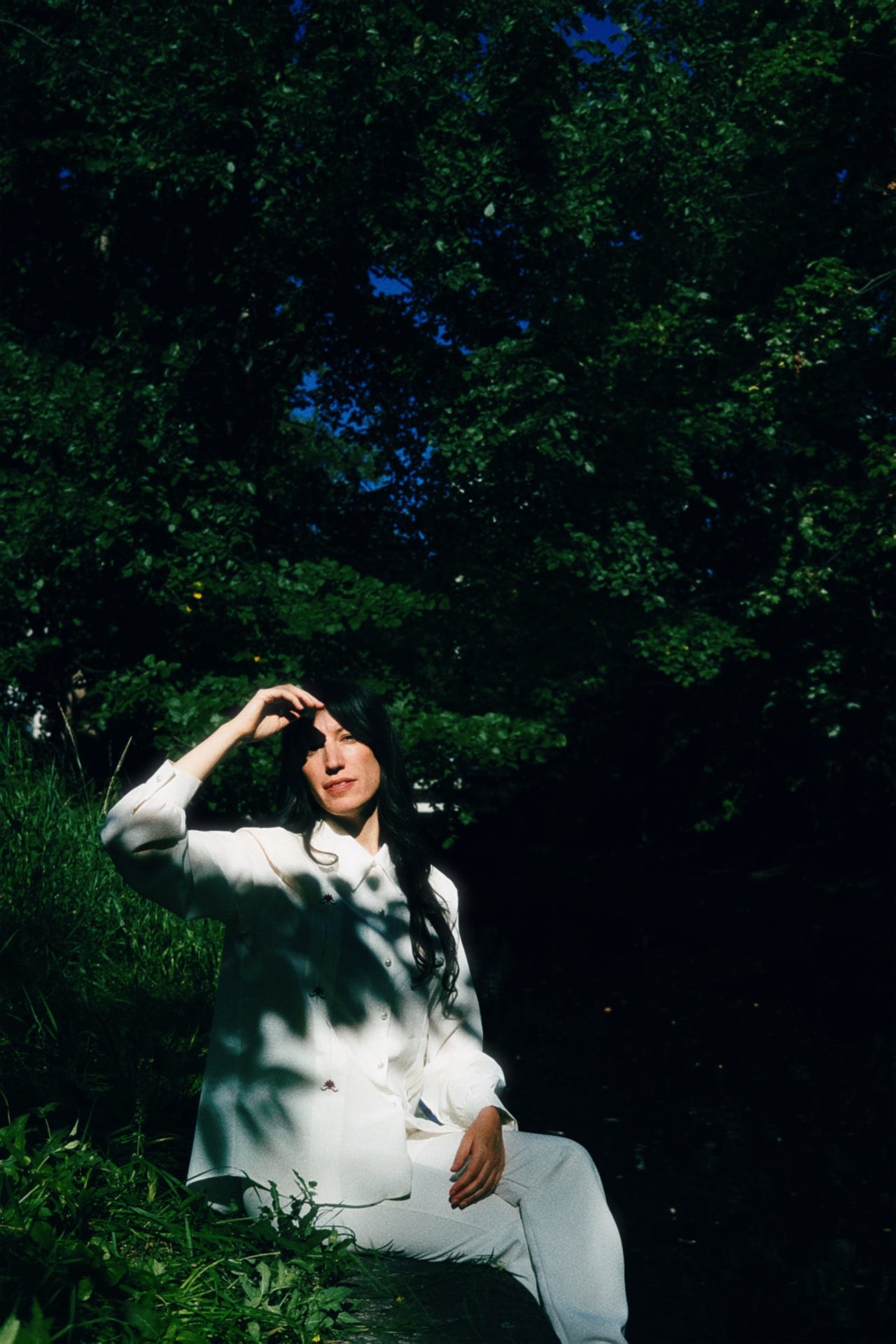
Ángeles Rojas’ music has remained in my ears since MaerzMusik — not only as the memory of the concert, staged on a rotating platform behind the main stage of the Haus der Berliner Festspiele, but as a source that resonates with a wider musical curiosity that continues to move through Berlin. Her work shares certain concerns with composers such as Catherine Lamb: close frequency relations, sustained tones, alternative tuning systems, harmonic spectra and forms that unfold over long stretches of time. It also meets a looser field around drone, spatial performance and kinds of listening that ask the ear to slow down. Other routes into this territory can be found this year in Catherine Christer Hennix’s exhibition Cosmological Critique at the Badischer Kunstverein in Karlsruhe and, closer to home, in Sarah Davachi’s October concert for solo organ and ensemble at the Kaiser-Wilhelm-Gedächtniskirche, presented by CTM. Rojas’ latest Warm Winters release, Open the Windows and Let the Spirits In and Out — out since June, documenting a 2023 live performance on the Klais organ of the CCK’s National Auditorium in Buenos Aires, commissioned by the festival RUIDO — draws these connections back into the particular acoustic world of her own work.
The music may alter one’s sense of time or sharpen one’s attention, but Rojas does not treat that state as a fixed compositional goal. She invites us to arrive there through the act of following the sounds closely. As timbres and frequencies begin to overlap, the sources can become difficult to separate. A sound produced by one instrument seems to continue inside another. At times, it becomes unclear who or what is making the sound at all.
Rojas speaks about her music through resonance, vibration, intonation, microtonal beating and slowly unfolding forms. These terms can suggest something stable or meditative, but that is not where the work begins for her. She starts with concrete questions about acoustic behavior: the way two close frequencies produce beating patterns; how those patterns change according to tuning and timbre; how a room begins to resonate; or how faint melodies can seem to appear inside a dense field of overtones.
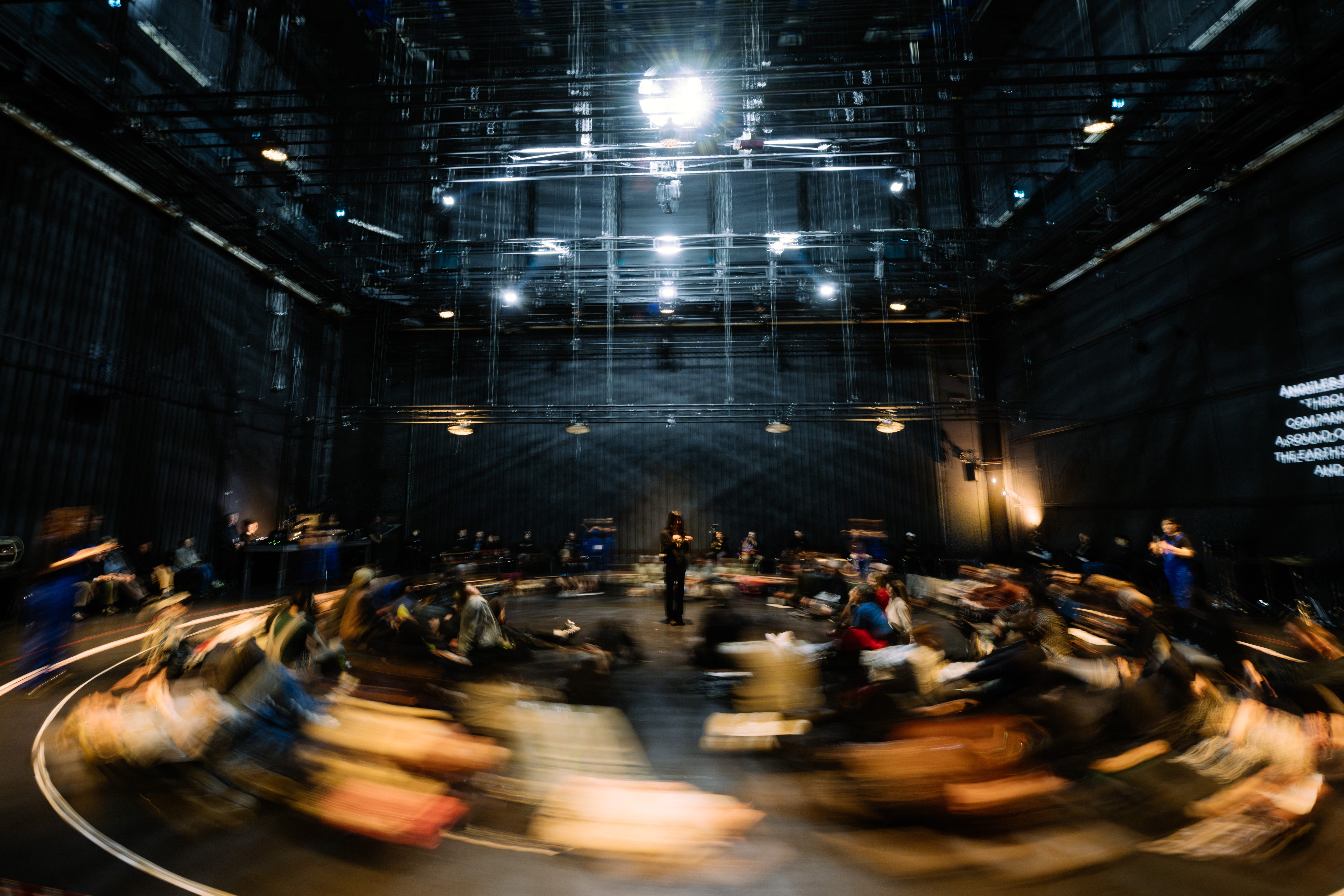
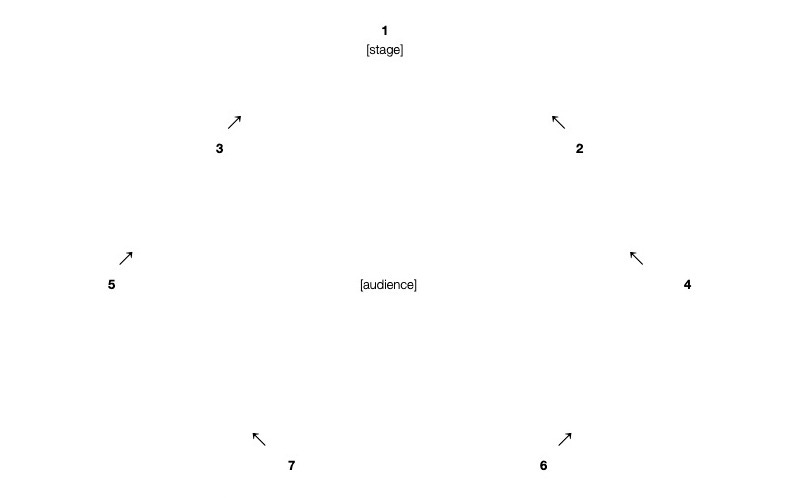
At MaerzMusik, these acoustic questions were both made physical and social. Rojas described the piece to me with the phrase “temporal confusion together.” Seven performers were spread across the space. The score had a structure, but no single pulse governing everyone from above. Instead, each musician responded to the person beside them, becoming a kind of echo. The delays between their actions gradually shortened until a shared tempo began to form. As this happened, the performers also moved physically closer together.
The performers have to go past the notion of a finished piece to be achieved. They have to listen, adjust and find their way into a relation that could not be fully decided in advance. The music emerges through that collective negotiation.
Her work brings together tuning, duration, physical space and social interaction without forcing them into a single metaphor. It asks practical musical questions that also carry wider implications: How does one sound remain alive inside another? How can people arrive at a common tempo without becoming identical? And what happens when a piece is understood not as a closed form, but as a condition that performers and listeners enter together?
Gabriel: Your music is often described as immersive or meditative, but underneath that there is very exact work with frequency beatings, intonation, and timbral convergence. When you begin a piece, do you start from a desired state of listening, or from concrete acoustic relations that might eventually produce that state?
Ángeles Rojas: I always begin from the desire to explore specific acoustic phenomena. So in that sense, it moves the other way around: from method to atmosphere. I am interested in phenomena that require a very attentive listening state - for example, how frequency beatings change depending on tuning or timbre, how resonance interacts with space, or how inner melodies emerge from overtones in sonic spectral situations.
All of these require deep attention to be appreciated, so to speak. Because of that, a certain state of listening inevitably appears for the performers, the audience, and myself. So I would say that this state is not intentional, but a condition. That is why I do not really like to categorize my music as simply atmospheric or focused on deep listening, drone, etc. What I want to listen to are organic results of some acoustic phenomena being presented.
Gabriel: That distinction feels important, especially now, when “immersive” can become a vague label.
Ángeles Rojas: Yes, exactly. For me, the point is not to create an atmosphere from the outside, a “cinematic and immersive experience”. It is to create the conditions under which something can be heard more fully. In pieces built from sustained tones, what keeps a sound alive is that you begin to hear its subtle variations, its inner melodies, its own internal form of life. So it is not about wanting continuity in an abstract sense; it is about listening to what is already happening inside the sound. I call that the immanent sound - something that lies behind the evident.
Gabriel: In the score you shared with me, and performed during the MaerzMusik piece, you write about “solving temporal confusion together.” What does that open up for you compositionally?
Ángeles Rojas: Mainly I’m interested in generating an experience—not only for the audience, but also for myself and for the musicians I work with. A social experience. That is why I like to work with listening. The score is structured, and I do like structure very much, but I also like to leave things open and work them out together with other people.
So in this piece I did not want to fix any pulse. I wanted us to listen and try to find it together. The idea is that we gradually arrive at the same tempo. At the beginning everything is like the echo of another sound. You become the echo of the person next to you, like a long delay of the person beside you. But at some point, you start to walk toward the same tempo—not only by reducing the delay, but by physically walking toward the other person. What happens in the sound also happens in the body.
Gabriel: So the form is also social and spatial from the beginning.
Ángeles Rojas: Yes. At the beginning the players are distributed through the space, and the idea is simply to follow. Then gradually everything comes together. I really like this movement from distance toward unity, not because distance is negative, but because becoming together gives me hope. It felt that way very physically when I performed the piece myself for the first time. At the beginning I was alone and very focused, and then suddenly the first person came close to me. The feeling changed completely as other performers came close. It became something very social. For me, that social dimension is more important than the sound result in isolation, even if the sound result is also beautiful. It was also important to me that we ended in a line, not a circle. A line is more open to the audience - and a little more exposed. It is like a happy ending.
Gabriel: In your work, echo seems to matter not only as an acoustic phenomenon, but as a relation between people. Was that already part of the piece’s conception, or did it emerge through rehearsal?
Ángeles Rojas: It was already part of it. I have worked with echo for a long time. I really love the acoustic phenomenon itself - when it happens naturally in a space it is amazing! But when you do something similar with performers, the perception changes. It expands. You have the echo of the space plus the echo of the performers, and suddenly the whole space feels larger. Perception becomes a little disturbed, in a good way.
It is also a very direct way of working with performers. If I tell you that your task is to echo the other sound, then immediately you have to listen to the other person. You get confused about who is who: am I the one playing, or am I just continuing what I heard? I like creating that kind of perceptual blur. It keeps everyone more present. And socially, it is important to me because it is also about influence. We are all affected by others all the time. Even if you do not want to be, you carry something from the other person. I think live performance can make that very tangible.
Gabriel: That also seems connected to your writings, where echo becomes a way of describing chains of interpretation.
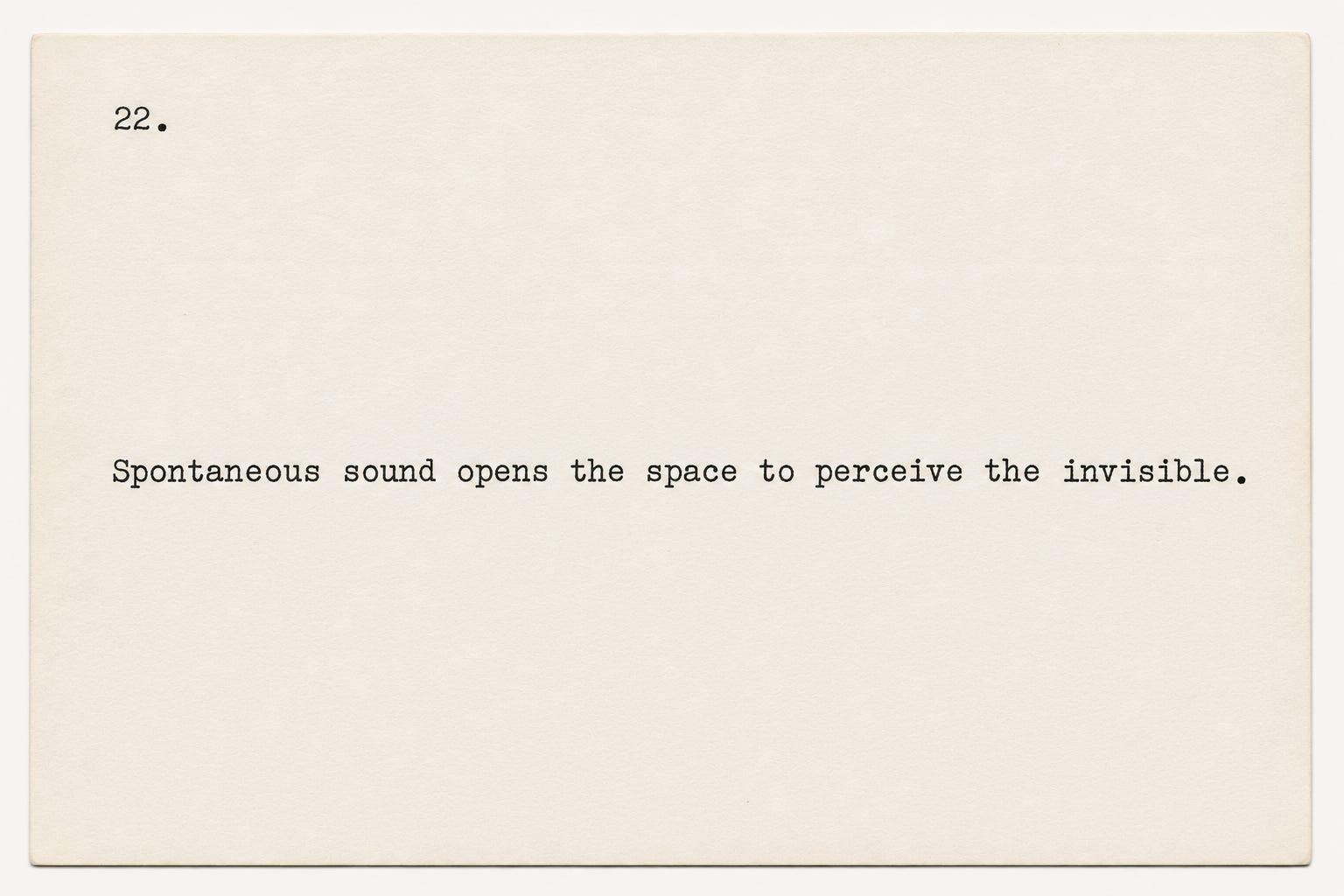
Ángeles Rojas: Yes. In the writing cards, echo is not only an acoustic phenomenon; it is also a social one. There is the book, then the writer who interprets the book, then my own interpretation, then the reader. There is already a chain of influences there. In that sense, even without conventional sound, there is already a form of music composition.
Gabriel: A lot of your work seems to be interested in small, highly resonant instruments - finger cymbals, shruti box, etc. What draws you to them?
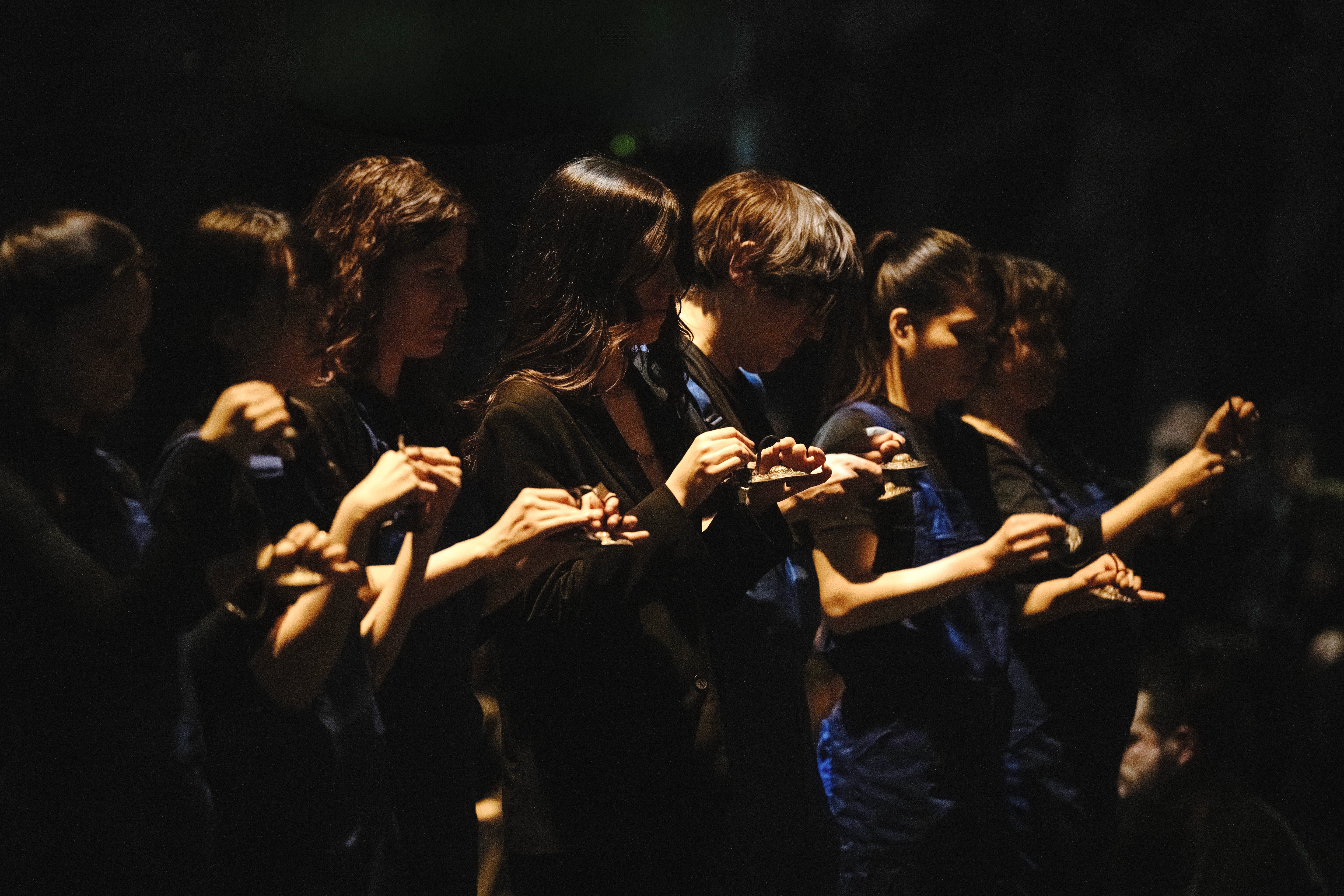
Ángeles Rojas: First of all, for the MaerzMusik piece, I wanted something small and humble that you can walk around with, because I really like to work with space. Mobility is important here. So those finger cymbals were perfect. But beyond that, I am always interested in instruments that generate something special in perception. The most important thing for me in this piece was the resonance and the tuning.
I chose these Tibetan instruments very carefully. I ordered them and started studying the tuning, then selected a set that worked together in the way I wanted. What I really love is not so much the strike itself, but the resonance that remains afterward. How it stays in the space, how it feels even when played close to the ear, how these tones mix when everyone is finally sounding together. That mixture is very strong physically.
Gabriel: You also mentioned shruti box and voice during our conversation… Is there a relation to be made between them and these ideas?
Ángeles Rojas: Yes. The shruti box is a great example - a small instrument, but one that carries a lot. I think I am drawn to these kinds of instruments because they do not demand virtuosity in the usual way. They do require technique, of course, but not the kind that puts display at the center. What they require is attention, subtlety, and care.
The voice is similar for me. Not singing in a perfect or trained way, but simply using the voice. Not looking for perfection, but just singing. We are resonant bodies, and when you start to explore voice privately, just for yourself, it is incredible. You feel those vibrations inside the body. It is very direct.
And of course I love the organ - but the organ is like a huge shruti box.
Gabriel: A lot of your work seems to move toward unity, but not by eliminating difference. How do you understand that?
Ángeles Rojas: The social aspect of my work is very important. Ensemble tuning is, for me, literally a way of learning how to be together. Not metaphorically - literally. I am not interested in erasing difference. Differences are important. What interests me is the possibility of making something together despite those differences.
When I orchestrate, I am often interested in monochromatic timbres and blurred sonic images, where it becomes difficult to identify who is producing what. That creates a kind of unity, but not because everyone becomes the same. It is a common space beyond difference. That is, hopefully, compelling for the listener, but also for performers, because it asks for another kind of attention and focus on what’s emerging in the moment.
Gabriel: That idea of becoming together feels especially strong in the MaerzMusik piece because it begins with delay and gradually turns distance into a meaningful relation to be aware of it’s development throughout the performance.
Ángeles Rojas: Yes. At the beginning everything is apart. That is also beautiful. But I like the idea of coming together. It gives me more hope. And in the piece, that process is not only symbolic. You really feel it. You start with distance - in space, in time, in pitch (note) relation - and then gradually you inhabit another state. So formally, yes, there is also a structure there. At the end, when everyone is finally together, the players begin to drop out one by one until only one remains, the highest pitch. So the piece has a shape, but that shape is still carrying something social and experiential inside it. During rehearsals we spoke about it as a kind of gravity. One performer keeps a steady tempo, and the others are gradually pulled toward it - the closer you come physically, the closer you come in time. I believe in that gravity in friendship too: when you resonate with someone’s ideas, you end up next to that person at the party. For me, that is also resonance.
Gabriel: What does this kind of music ask of performers that conventional conservatory training sometimes misses?
Ángeles Rojas: For me, it is mainly about being present. In rehearsal, once the main idea is clear, it is not about repeating technique in the conventional sense. It is about going deeper into the piece. Something happens in a lot of these works that is difficult to explain, but it becomes more personal. The performers stop acting as performers in the usual sense. They are simply inside the piece.
This requires a lot of attention. You have to put a lot of yourself into it. You have to be super present. You have to listen to the other person. You have to make a very subtle sound. You have to be careful. So even if the gesture is simple, the demand is actually very high. But because it is so focused, you suddenly forget that you are performing. You are having an experience with the other people, and only afterward do you remember that there is an audience in front of you. That is why it can feel intimate and exposed at the same time.
Gabriel: So technique shifts from control to perception?
Ángeles Rojas: Yes, exactly! Sometimes I even have to tell performers: please do not do the usual percussion gesture. Do not accent it. Do not show it. I do not want to know in advance when you are going to hit the instrument. I want the action to be as simple and ordinary as possible, because exaggerated gestures pull the attention somewhere else. I want to let the sound be. That is a kind of technique too - maybe a more important one for me…
Gabriel: Your work often evokes wind, forests, earth, seeds, birds. But it never feels illustrative in a simple way. What interests you in nature here?
Ángeles Rojas: Not nature as image, but nature as condition. I grew up very close to it, so I feel naturally connected to it. Wind, especially, affects me very strongly. Later I realized that this may be connected to where I grew up—a very windy, open, somewhat isolated region. Wind that travels continuously, carries sounds, collides with things, makes them vibrate.
What interests me is not “nature music” in any decorative sense. It is that nature is constantly in movement, constantly connecting things, constantly transforming them. That is also how I like to think about music: not something fully controlled from above, but something that follows its own process, its own time, like trees, wind, rivers.
Gabriel: So nonhuman time is also structural for you?
Ángeles Rojas: Yes. It teaches me that we cannot fully control anything, and that we need to allow things to follow their own process and time. Structurally, that means allowing a piece to emerge from within rather than imposing a fixed form. Time becomes relational, not linear. And again, that returns to unity—not sameness, but coexistence.
Gabriel: You also write, and you make these text-based listening works. What can language do for your practice that sound cannot? And where does language fail?
Ángeles Rojas: Usually ordinary language fails for me, and I prefer sound. There are things language simply cannot grasp, which you can perceive by staying in silence. And by silence I mean a state of openness, not something imposed.
However, I would like to write more, but I also feel that some things are better protected from being fixed too quickly into concepts, because once something becomes a concept it can be absorbed by institutions and lose the sensitivity of the original search. Listening is a good example. It is a meaningful word for me, but nowadays I sometimes find it hard to use, because it has been overused and institutionalized. It can become branded, taught, even monetized, as if it were something to acquire, rather than a direct experience open to everyone.
Gabriel: And yet writing remains part of the work.
Ángeles Rojas: Yes, because writing and reading are not separate from music for me. They are another kind of music: the sound of thought, pauses, reflection, interpretation. Words can also create echoes. So even if sound is still primary for me, writing can open another way of listening.
Gabriel: At a festival like MaerzMusik, where listening is often framed as spatial, multimodal, and collective, what kind of listening community do you hope your music briefly produces?
Ángeles Rojas: I hope the audience can connect, even briefly, with the present moment, and experience a sense of wonder toward sound, as I do. For me, the audience is as important as the performers. I hope they are also having this experience of focused or open perception, of really being there.
I think we live in a moment where it is very easy to be distracted. Even for me. So going to a concert can become a way of saying: now I am only going to focus on what is happening. That is what I want to make possible—a good experience, but not in a superficial sense. A state in which attention stays alive.
Gabriel: That also makes this conversation feel like something that extends beyond the festival itself.
Ángeles Rojas: Yes. I think these questions continue. The festival is one moment, but the practice of attention with listening habits continues in other places, with other people, in other forms. For me, continuity is very important.