

The Next Day Interview: Catherine Lamb
Catherine Lamb is a composer whose work turns tuning into a practice of relation between tones, performers, bodies, and the spaces in which they meet.

Returning to Catherine Lamb’s work after MaerzMusik does not feel like looking back at something already finished. The questions her music raised are still moving through Berlin: in concerts built around long durations, non Western tuning systems, spatial sound experiences, festivals and the simple demand that an audience spend more time listening.
Lamb is a North American composer known for music that unfolds slowly through sustained tones, the voice and carefully tuned instrumental harmonies. She writes for ensembles, soloists and electronic sounds, often collaborating with musicians over long periods to develop pieces in which tuning goes beyond fixed ratios and is shaped through active listening. Her output can be framed as experimental composition, but it draws as much from acoustics, vocal practice and the physical experience of sound as it does from written Western traditional musical systems.
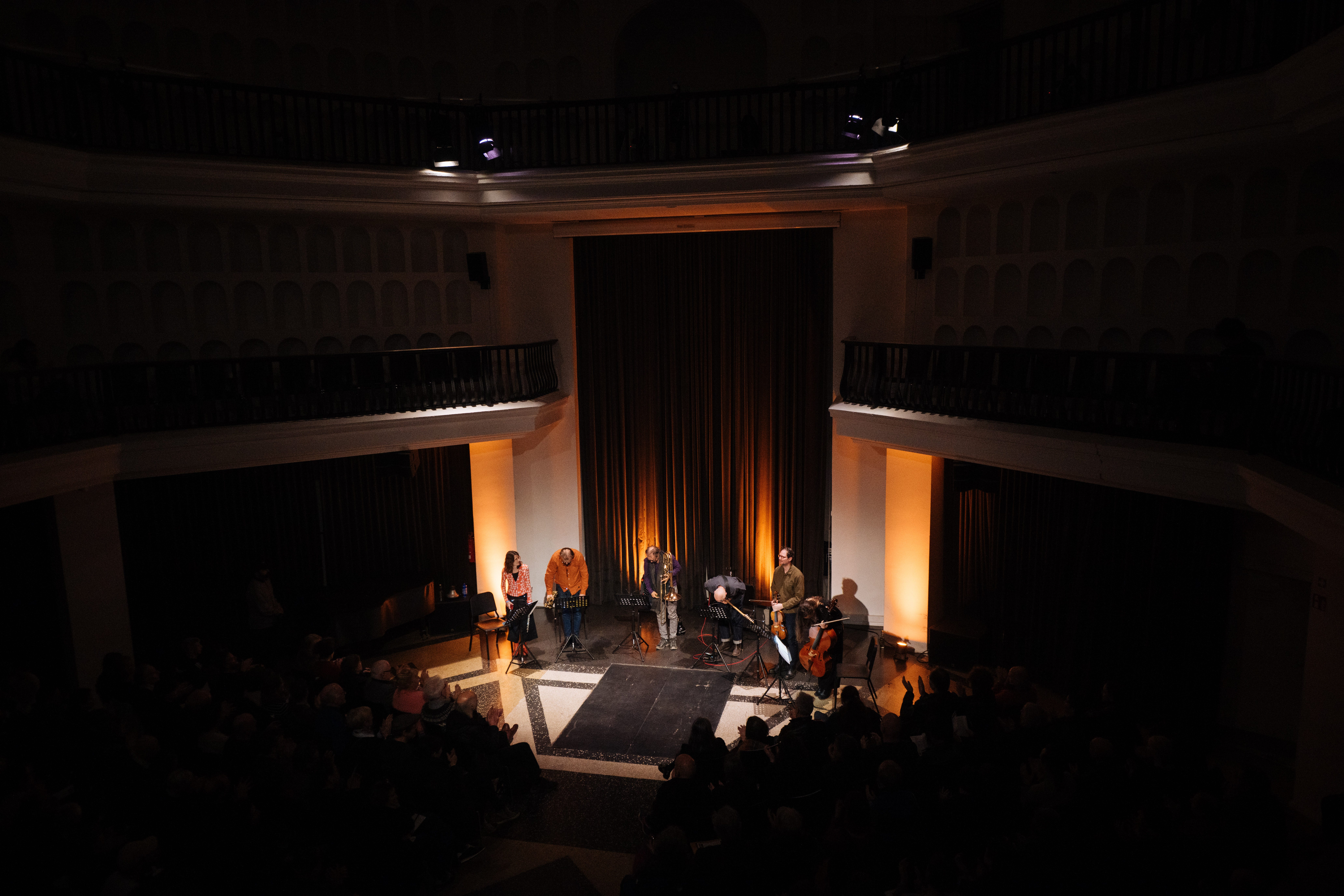
A central part of her practice is just intonation. The term can sound more forbidding than the experience itself. In practical terms, it means tuning notes according to the natural relationships between sound frequencies rather than relying only on the equally spaced intervals of a modern piano. When these relationships align, tones can fuse with unusual clarity. When they fall slightly out of alignment, they produce audible pulsations, sometimes called beating: a gentle throbbing created when two nearby frequencies interfere with one another.
These effects are not decorative details in Lamb’s music; they are part of its structure. Voices and instruments meet inside a resonance that is never entirely stable, because it changes with the performers, the acoustics and the act of listening itself. Pitch becomes something negotiated in real time, shifting with breath, attention, balance and the particular conditions of a performance.
The conversation below begins with Lamb, but it reaches beyond a single composer. It touches on resonance, the body, musical time and the ways sound can be shared between performers, listeners and a room. Beyond MaerzMusik, these concerns run through the sonic life of the city: in CTM’s concert programmes, in large-scale projects such as Berlin Atonal and Unsound’s The Infinite Now and RIAS Kammerchor presenting their Mit den Vögeln singen, both at Kraftwerk, and the Orchestral Series at Halle am Berghain, to name just a few occasions where sound is presented less as a sequence of works to consume than as an environment to enter.
Her music also offers a useful way into questions that recur throughout Berlin’s contemporary scene: how sound shapes a space, how listeners find their way into unfamiliar music, and how a composition can be experienced as a set of relationships rather than as a fixed object.
In conversation, Lamb repeatedly returns to the listener. She has no interest in defending complexity for its own sake, or in reserving microtonal music for people with specialist knowledge. Microtonality, here, refers to the use of pitches and intervals that fall outside the familiar notes of a piano or standard Western tuning. A listener does not need to identify those intervals by name in order to hear what they do.
What the music asks for is a different kind of commitment: time, concentration and a willingness to stay with sounds that do not immediately explain themselves. Listeners can enter through changes in resonance, through tones that seem to merge or separate, or through the way a harmony alters the apparent size and depth of a room. The ear adjusts gradually. Relationships that once seemed almost static begin to reveal movement.
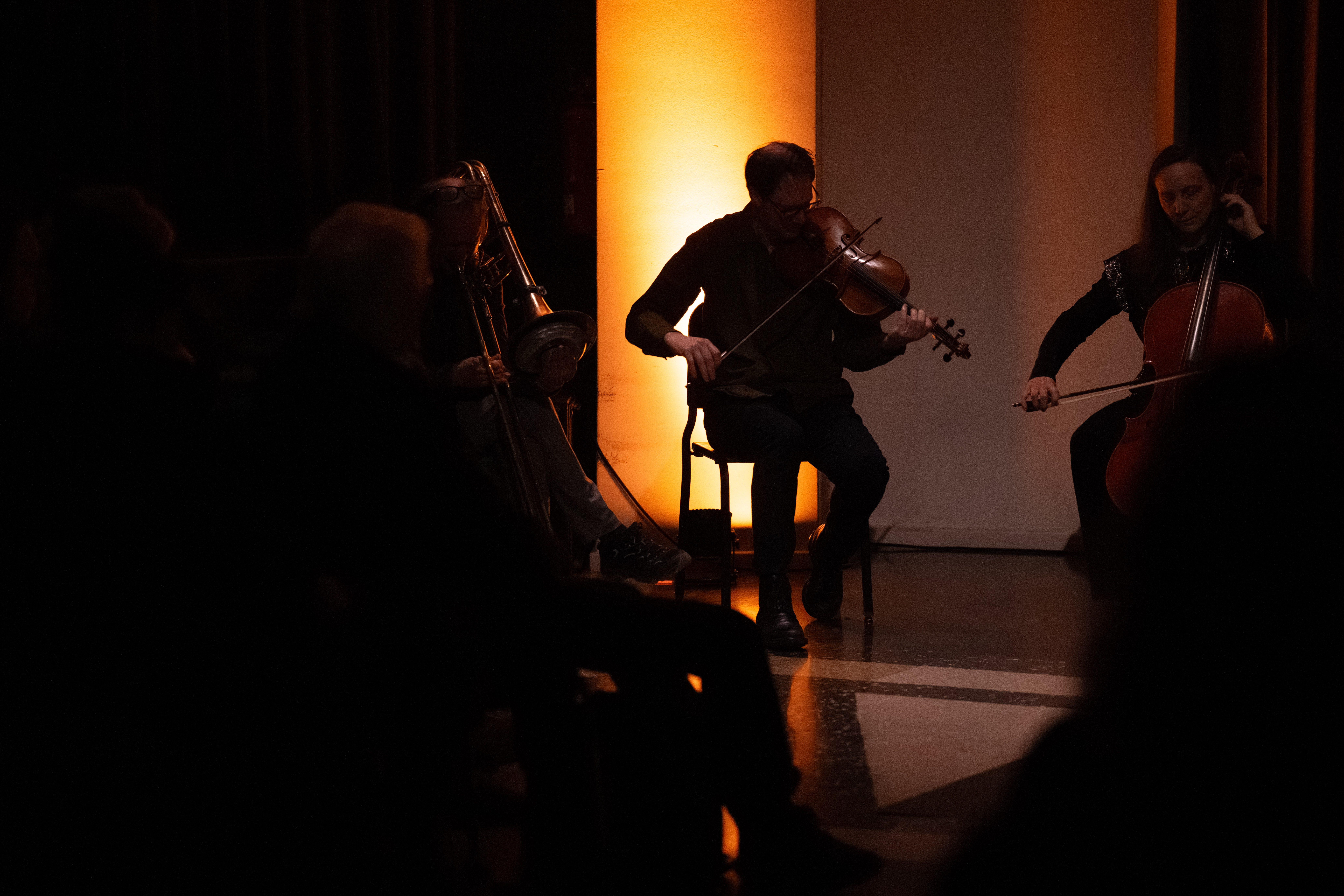
Such listening is increasingly present in Berlin outside the conventional concert format. It appears in durational events, installations and programmes where people are free to move between close attention, peripheral hearing and rest. In these settings, listening is not treated as a single uninterrupted state. It can drift, return and deepen over time.
Lamb describes forms that develop through arrival rather than rhetorical climax. One reference is the alap, the non-metrical opening of a raga (an Indian classical melodic framework built on a set of notes), in which the tonal character of the raga is introduced gradually, before a regular pulse or rhythmic cycle begins. The musical world is not presented all at once; the listener is brought into it step by step.
For Lamb, this becomes a way of thinking about musical form. One sound prepares the ear for another. A relationship becomes audible before it changes. Consonance and dissonance no longer operate only as stages in a familiar pattern of tension and release: they can be heard as fusion, friction, blooming, movement or shifts in depth.
The result is music concerned with how sounds appear — how one tone changes the perception of another, how a harmony gathers inside a room, how a listener’s sense of time transforms while remaining with it. This places her in dialogue with other strands of Berlin’s current programming, from experimental festivals interested in resonance and dissonance to the long, immersive structure of clubbing, where sound and duration occupy the same ‘ritualistic’ field.
The relation between tuning and the body becomes especially clear when Lamb speaks about the voice. Singing, in her account, is not only for trained vocalists; it is a direct way of learning how harmony behaves. Vowels, breath, resonance and physical vibration make intervallic relationships perceptible from inside the body. Through the voice, a harmonic relationship stops being only a ratio or a position within a system and becomes something felt in the chest, mouth, skull and surrounding air.
This grounds Lamb in a lineage of tuning-based composition, and also in a wider set of practices that understand listening as physical, social and environmental. It is one reason her voice felt like the right one to open this series. From here, readers can move toward other Berlin encounters with just intonation, microtonality, drone, resonance and long duration: forms of music that ask an audience to inhabit time differently.
By the end of our conversation, tuning had become more than a compositional technique. It emerged as a way of being with other sounds and other people: listening closely, making adjustments and allowing several forms of presence to coexist without forcing them into a single standard of precision.
Gabriel: When someone encounters your music for the first time, what do you hope might shift in their listening? Is it their sense of pitch, time, awareness, or the experience of listening with other people? How do you hope a listener enters your work?
Catherine Lamb: I’ve mentioned this in other contexts, but Maryanne Amacher was talking in the 1990s about reaching an age of the ‘new listener’ – a listener that goes beyond the concert hall, and also beyond a simple opposition between electronic music and acoustic music. This perspective shifts the focus more toward the role of the listener itself, and toward a growing capacity to hear more complexity.
Of course, that’s not universal. It’s not something generic... Maybe it’s happening, maybe it isn’t. But what I’ve found is that people do not need a lot of prior knowledge in order to enter music. Sometimes people assume that to understand this kind of work you need to have studied just intonation (or any alternative tuning systems besides Western chromatic equal temperament), or partials, or harmonic theory in a specialist way. But actually the main thing is much simpler: if people have the willingness to stay somewhere for a certain amount of time, and to work on their listening capacities, that’s already enough.
Gabriel: That feels particularly urgent now, when attention is so fractured.
Catherine Lamb: Yes. I notice it with some of my students too. Because of devices and the constant stream of information, attention spans seem shorter and shorter. So in a way there’s almost a double movement: maybe our ears are evolving, maybe we are more aware of more things, but at the same time we live inside forms of distraction that make sustained listening harder. I think listening now often requires a conscious stance – just deciding: ‘I’m going to be the listener now, and that is my role.’ What people then take from that willingness is up to them.
Gabriel: I was thinking about that after the Haas concert. A friend of mine loved it partly because it gave her an hour in which she didn’t have to look at her phone. That felt surprisingly unexpected but also relevant.
Catherine Lamb: Yes, I think music can offer that kind of space. It can offer a place where you don’t have to respond to communications or interruptions. You can just be there.
Gabriel: I was thinking about that after the Georg Friedrich Haas concert. I brought a friend - a genuine Swiftie, not a new-music person at all — and she loved it: she said she got goosebumps three times, and that it was a full hour in which she didn’t have to look at her phone.
Something I hear in your work is a kind of arrival-form: not landing inside a structure that is already fully given, but gradually entering it. I’m thinking here of your relation to Indian music, and to the idea of alap. What drew you to that?
Catherine Lamb: When I first learned about alap and what it does, I was fascinated by the way it gives time and space for a sonic material to unfold. But it is not only that the musical material unfolds – you also get fragments of the compositional form itself. You begin to understand the identity of what is being shaped as each tone enters the listening field. One tone appears, and then another, and another, and that process allows the listener to arrive with the material rather than simply be confronted with a finished artistic object.
This idea of arrival became very important to me. Not all of my pieces follow that model, but I return to it a lot because I find it is a very special way to set up an experience.
Gabriel: What I find compelling in your work is that this also changes the listener’s relation to form. It feels as if spaces are being opened one by one, almost like rooms. Each moment doesn’t just state something – it suggests where one might go.
Catherine Lamb: Yes, I think that’s right. I don’t necessarily think in terms of building toward a climax. I do think a lot about consonance and dissonance, but not in the sense of teleological buildup. For me it’s more about movement, about how things bloom, or rub against one another, or unfold through resonance.
Gabriel: So consonance and dissonance remain important, but they operate differently.
Catherine Lamb: Exactly. They still matter a great deal, but more as modes of motion or relation than as steps in a dramatic arc. I was thinking of that very strongly in the Georg Friedrich Haas piece: when he uses those overtone-rich areas, it’s amazing how suddenly a kind of crazy fusion emerges out of dense, chaotic material. Suddenly there is this strange dimensionality. And that isn’t because there are simply many musicians in the room – it’s because of what the harmonic relationships themselves are doing with our listening. It’s because of the low-order harmonic series – what those simple relationships are doing with our listening.
Gabriel: That passage also made me think about the difficulty of language here… how often words fail when we try to describe these phenomena.
Catherine Lamb: Yes, absolutely. There are all these different states – brightness, mellowness, openness, comma flickers, chain resonances – and language doesn’t always keep up with the experience. But the perception is very real. You sense how something is functioning, even if naming it is imperfect.
Gabriel: This reminds me of James Tenney’s thinking and music somehow… and of this whole question of Gestalt: the way events are perceived not only in themselves, but in relation to what comes before and after them. This motto that the “whole is bigger than its parts”...
Catherine Lamb: Tenney was very important to me. He was such a generous teacher, and his incorporation of the idea of Gestalt – the form of things, the way combinations emerge, the way sequence affects perception – stayed with me a lot. Something is never only what it is in the present. It is also how it relates to what came before and what might come after. That relation blurs time in a productive way. I think a lot about what he said about how things combine and clump together – what he called a ‘clang’ – these combinations that happen if you allow the space for them.
Gabriel: Your vocal works often feel like major points of entry for listeners who might not come to this music through specialist terminology. In those pieces, words often recede and vowels become structural. What can the voice reveal about harmony that instruments alone cannot?
Catherine Lamb: What I love about the voice is how direct it is. I always encourage students to sing – whether they are composers, electronic musicians, instrumentalists, whoever. Even if they don’t feel they have the capacity, I still encourage them to do it, because the act itself teaches you so much. Even if you just put an oscillator on and try to tune against it, moving your voice around and changing the shape of the vowel, you learn a lot very quickly.
The voice may be difficult to control in a conventional sense, but perceptually it can get you there very directly. You hear immediately when a relationship locks in. You feel it physically – in the skull, in the shape of the vowel, in the resonance. That’s one reason I’m so interested in phonemes and vowels: you can literally shape the voice. A trombone is still a trombone, even with different techniques or mutes, but the voice remains extraordinarily open.
Gabriel: So the phoneme is not only a timbral basis for spoken word and language…
Catherine Lamb: No, not at all. Right now I’m working with a vocal group, and although I may start with IPA or phonetic indications, I don’t think of that as an endpoint. It’s more of a starting point. What matters is not ultra-precision in a rigid sense, but exploring changes intuitively, hearing how the filtering of the harmonics shifts as vowel shapes shift. Those changes create complexity, but they also invite a very immediate form of listening. If the bass voice is singing really open, with an open ‘aw’ sound, it’s inviting a lot in.
Gabriel: You also spoke elsewhere about resonant filters and room-dependent work. How much of a piece exists conceptually or symbolically on paper, and how much only comes into being when a room starts to answer back?
Catherine Lamb: I think a piece can exist in different ways. There is a conceptual side, and there is an experiential side, and what is beautiful is when those two can merge without the listener having to separate them. You’re not standing there thinking, ‘Now I am processing the concept.’ It just comes together in the experience.
I’m very interested in whether a piece can retain integrity across different kinds of spaces: a dry room, a resonant room, inside, outside, porous, focused. What I want most is flexibility. I don’t want the work to depend on one ideal condition only. In that sense I’m different from Amacher – for her it was almost the opposite: the materials belonged to the room, each room was a piece. I admire that, but what I want most is flexibility.
Gabriel: That flexibility also seems built into the way you write, no?
Catherine Lamb: Yes. The thing I leave most open is timing. I don’t use very precise rhythmic notation in the conventional sense. More recently I’ve been working with noteheads that indicate different roles – a melodic tone, a harmonic tone, a pedal tone – and these roles affect how momentum moves. Sometimes you wait for a sound to bloom before moving; sometimes you sustain it in relation to the others. And the room affects all of this. In a dry space, things may move faster. In a resonant space, much slower. I find that very interesting.
What keeps me interested in being a composer, and in the score itself, is the generosity of that structure as it moves from person to person. Different realizations can happen; they can challenge the score, or reveal depths I didn’t know were there. I love that. I love the possibility that someone in Brazil, or Japan, or somewhere else enters the piece through this form of attention and gives it another life.
Gabriel: I want to ask one final question, because it feels central to your work. Can a different tuning system do more than reorganize pitch relations? Can it also model, or at least support, another idea of coexistence?
Catherine Lamb: I think one has to be careful, because there is always the danger of becoming ideological – especially of drifting toward something authoritarian or fascistic in the desire for precision. If absolute exactitude were the real goal, then I should probably just write electronic music, or only work with a tiny number of musicians who can realize an ideal version of the piece, and leave it there. But I’m not interested in that.
What interests me is the human aspect: approximation, approach, the excitement of getting closer, the way listening develops inside a group. Sometimes this can be frustrating, because audiences do not always hear how much labor is involved. They may think it sounds easy, or just ‘weird’ – just sustained tones, pretty harmony, whatever – without realizing how much care and work goes into that relationship. But precisely there, for me, something important happens.
A lot of the problems we are facing in the world come from hierarchical ideas – this is art, this is not; this is the right way to live; these people matter, these people do not. I’m not saying music solves that. But I am interested in removing the idea of the ideal virtuosic figure as the center of value. If people are tuning together, then they have to become very aware of how their sound combines with someone else’s sound. And that kind of attention matters to me very much. It asks for real acknowledgment of others. Maybe that is one small place to begin. That intensity of focus within a group – which I also hear in Éliane Radigue’s music – is what I want to concentrate on right now. It is honestly the only answer I have to the people who are destroying everything: to focus on being aware of each other. You exist; I am acknowledging you; let’s try this together.