


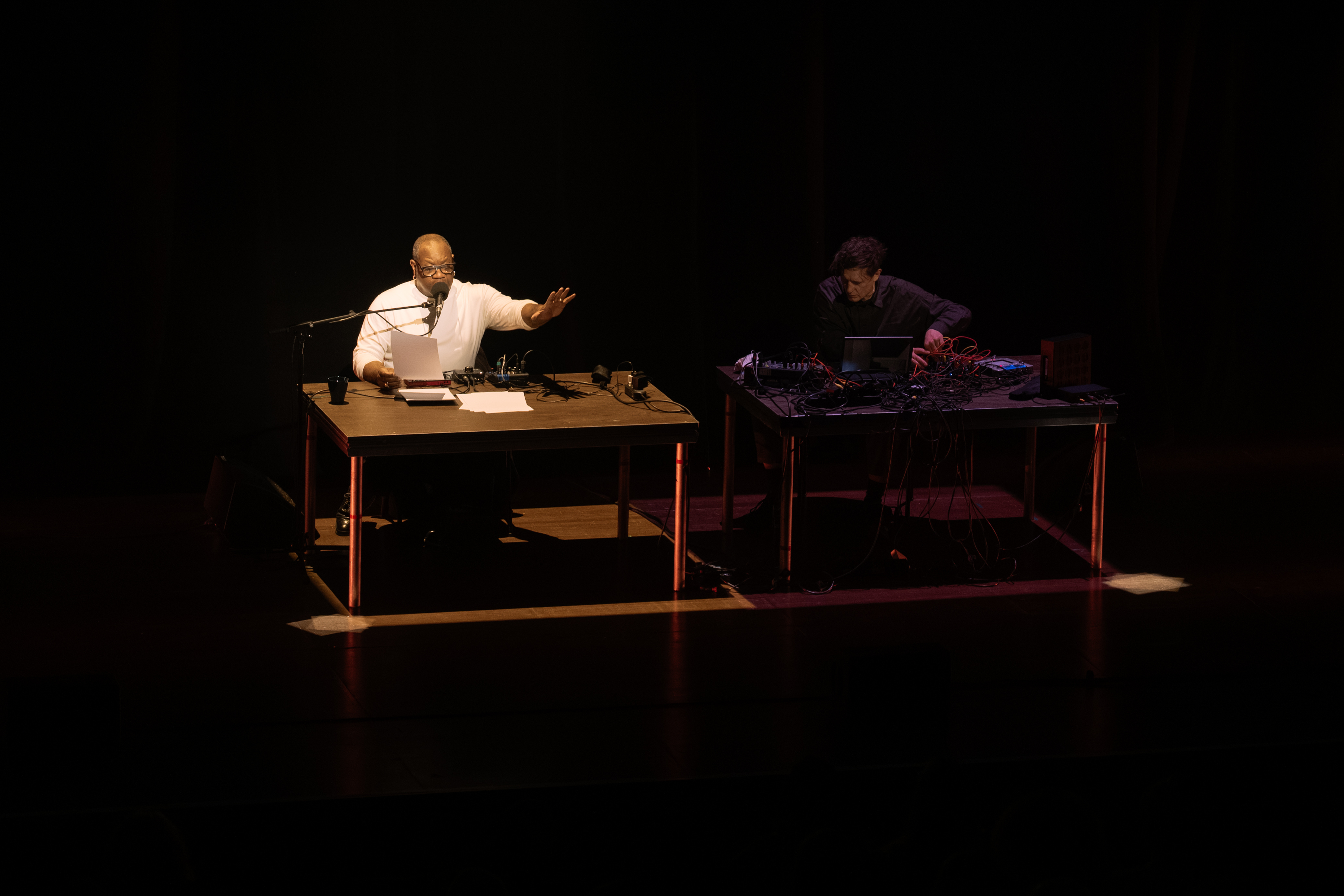
Louis Chude-Sokei enters this post-MaerzMusik constellation from a distinct angle. Where other conversations in this series turn on tuning systems, sustained tones, or the social life of resonance, his work routes those concerns through the voice — and toward another set of urgencies: the voice as critical instrument, identity as an unstable and historically mobile formation, the afterlives of colonialism, the politics of migration, the sonic life of theory, and the question of how thought becomes public without becoming merely explanatory. In No Nation Left But the Imagination, his collaboration with Jan St. Werner, scholarship is not simply illustrated by sound. It is broken open by performance — by breath, timing, repetition, electronic transformation, persona, humor, and the pressure of bodies gathered in a room.
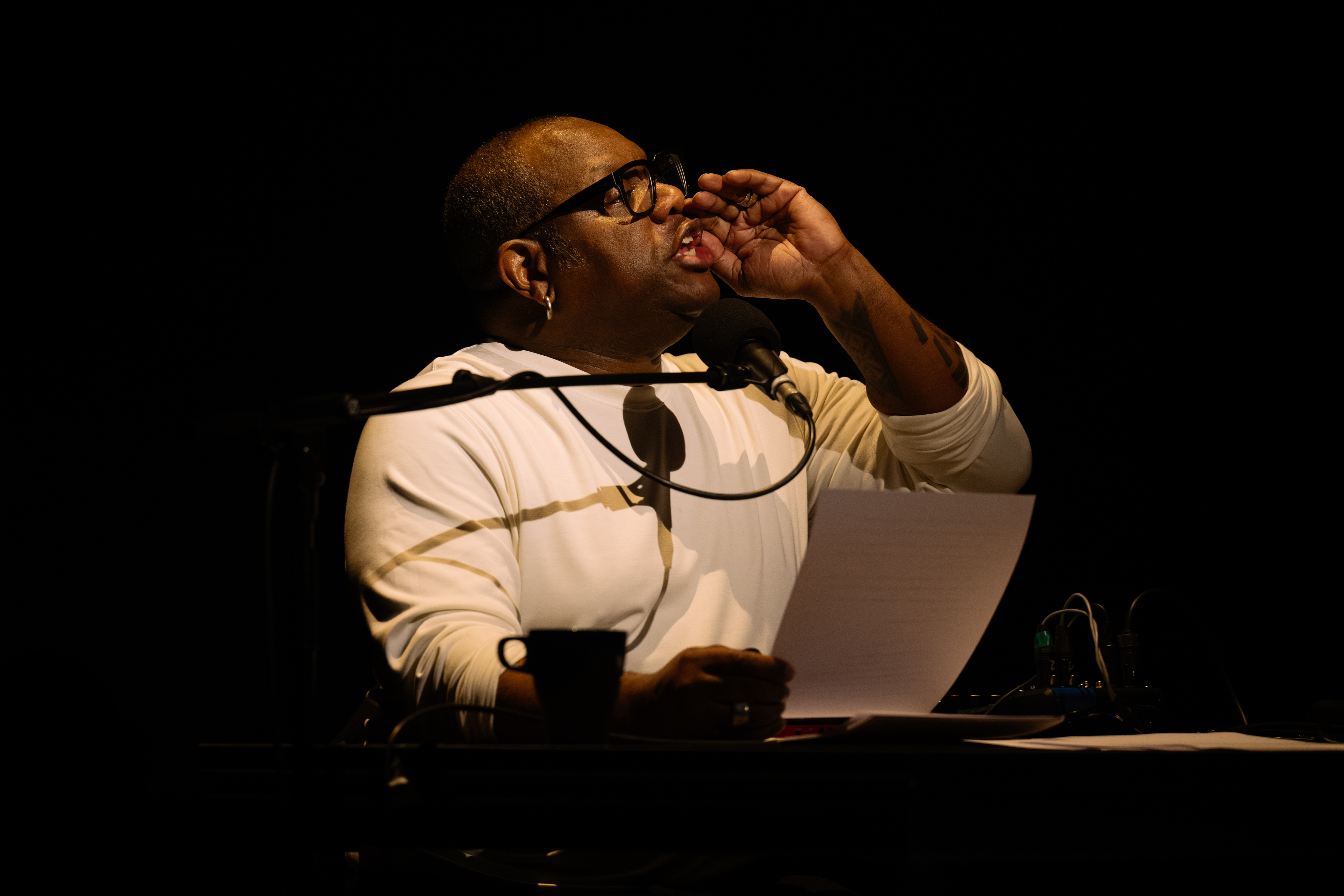
That rupture is what gives the piece its particular weight in the festival’s longer resonance. If MaerzMusik opened lines of inquiry around listening, space, collectivity, and the politics of sound, Chude-Sokei extends them into a register where theory, poetry, and performance become inseparable. The result is neither a lecture set to music nor a spoken-word act decorated with electronics, but something closer to a public theory of voice: an essaying in sound in which language can become rhythm, argument can suggest form, and conceptual tension invites an audience to witness social relations in the making.
Berlin matters here, though not in the easy sense of a ready-made capital of experimental culture. One of the most revealing moments in the interview comes when Chude-Sokei declines to claim any total knowledge of the city, noting that many of his stays have been short, project-based, and institutionally curated. Yet that caution is precisely what makes his connection to Berlin compelling. Rather than offering a visitor’s generic praise, he names where his work actually lands: the ongoing collaborations with Jan St. Werner and Mouse on Mars, the context of institutions like Haus der Kulturen der Welt, the Akademie der Künste, CTM Festival, the DAAD Artists-in-Berlin Program, and - perhaps most importantly - smaller exchanges with younger artists, activists, and diasporic communities working across African, Caribbean, Turkish, Armenian, Arab, and other minority-within-minority positions. This is the right frame for the city: not Berlin as a platform for experimental sound, but Berlin as a site where counterpublics, hybrid formats, and unfamiliar vocabularies keep meeting one another.
Chude-Sokei is, of course, already a major writer and scholar. Born in Nigeria and raised between Jamaica and the United States, he is Professor of English at Boston University, where he holds the George and Joyce Wein Chair in African American and Black Diaspora Studies, and for over a decade he edited The Black Scholar, one of the oldest journals of Black studies. His books - The Last Darky: Bert Williams, Black-on-Black Minstrelsy, and the African Diaspora (2005), The Sound of Culture: Diaspora and Black Technopoetics (2015), and the memoir Floating in a Most Peculiar Way (2021) - have shaped a generation of readers on diaspora, reggae, and the entanglement of race and technology; German readers may know him through the essay collection Race und Technologie: Essays der Migration (2023), and visitors to the 2024 Venice Biennale through the German Pavilion exhibition Thresholds, where he served as one of two chroniclers and contributed a sound work on the island of La Certosa. What becomes newly visible in this conversation, however, is how the voice itself has turned into fresh material for him - a musical and theoretical problem in its own right.
Years of collaboration with St. Werner and others have obliged him to hear his own voice not only as a carrier of meaning but as a sound with texture, breath, grain, and political exposure. The urgency is contemporary: the present technological moment has rendered the voice newly unstable - reproducible, regulatable, extractable, transformable. In that sense it becomes one of the last charged thresholds between the human and the inhuman, though he is wary even of the word “threshold,” preferring “transition,” since he is less interested in celebrating instability than in asking what kinds of collective futures might open through it.
Again and again, Chude-Sokei returns to forms of relation that exceed both academic discourse and cultural cliché: listening to each other’s listening; collaboration as trust plus agency; migration as an act of listening; humor as a necessary resource inside black and decolonial speech; eavesdropping as a way of learning from other discourses without pretending to own them. None of these are abstract positions; they are compositional, performative, and social methods. What emerges is not simply a portrait of a scholar performing, or of an artist speaking critically, but of a thinker using voice, electronics, theory, and improvisatory presence to ask what kind of community can still be made under conditions of surveillance, fragmentation, commodification, and an exhausted identitarian political vocabulary.
Gabriel: “In No Nation Left But the Imagination,” what becomes possible in performance that would remain impossible - or at least insufficient - in an essay?
Louis Chude-Sokei: Every form of writing allows and disallows something. Scholarly writing allows one thing, literary writing another, public writing something else. Performance is a different realm altogether because it takes physical space and physical bodies seriously. It has to think about what bodies do in relation to each other in space. That is what makes it both difficult and exciting.
What performance gives me, especially in this sound-and-spoken format, is access to the poetic as a technology of bringing things together that might not make sense on the page, but in shared presence make complete sense. The goal is not to translate ideas into something simpler. The goal is to create community, however briefly, through sound, voice, timing, and feeling. We are not naive: that does not automatically change the world. But feelings generated in a room do not remain in the room. They carry outward in ways that abstraction alone usually cannot.
Everything is rooted in research. No Nation Left But the Imagination actually begins as a lecture about Derek Walcott, the Nobel Prize–winning Caribbean poet. You can tell the story of Walcott’s work academically, or in a literary-critical way - but how do you do it publicly, in an engaging way? I am not a poet reading poetry. I want to do with essays and lectures what spoken word does with poems.
Gabriel: One of the striking things in the work you presented during MaerzMusik is that your own voice becomes a material under examination. What has changed in the move from being a writer to performing as a voice explorer?
Louis Chude-Sokei: This project forced me, for the first time in my life, to actually listen to what I sound like. For years I wrote books, gave lectures, collaborated with musicians, but I still thought of the voice merely as the vehicle for words. Working with Jan St. Werner, Mouse on Mars, and other collaborators has made the voice itself impossible to ignore.
In this piece, everything comes from the voice. Jan takes it and runs it through granular engines; I manipulate it myself in simpler ways with echo and timing; the entire sonic field grows out of speech. So suddenly I am not only thinking about meaning. I am thinking about breathing, phrasing, grain, the material qualities of the sound, and what other people have apparently been hearing in it all along. I do not yet have a final answer to what that voice is, but I know the question has now become central to the work.
Gabriel: In this kind of hybrid lecture-performance, have you discovered a persona in yourself - something that emerges when you speak publicly that you do not fully control?
Louis Chude-Sokei: Absolutely. Anyone who lectures for years eventually discovers that the figure the audience encounters is not identical with the one you imagine yourself to be. There is always a persona there, and people’s reactions make you aware of it, sometimes uncomfortably so. In this newer performance work, that is intensified because the voice is now the center of the piece.
One thing I have become very aware of is that there is a prophetic or preacher-like energy in how some of this lands. Jan once described it as “conversationally prophetic”, which I found useful. But I am also very interested in humor, because so much black speech, diasporic speech, and decolonial speech is not only solemn. It is full of jokes, teasing, side comments, shit-talking, coded references, and different levels of audience address. I do not want to lose that by becoming too sanctimonious. If you are talking about race and colonialism but you leave out humor, inside jokes, or the pleasure of language, then you are misrepresenting how people actually live and speak.
If I am talking about colonialism and I make a joke, a black audience gets it immediately. A room full of white Germans cannot allow themselves to laugh — they get very tight, very uncomfortable. But the joke is part of the argument.
Gabriel: At what point does language stop explaining and begin to behave like musical material for you?
Louis Chude-Sokei: For me that does not happen fully on the page. It happens in performance. A sentence can look dry in writing and suddenly become a moving moment once it is spoken, repeated, delayed, sampled, emphasized, echoed, or interrupted. Likewise, a line that looks incredibly musical in writing may die completely in public. So there is no formula. The transmutation only really happens when voice, electronics, pacing, and audience are all in play together.
That is why I am not too anxious about what to call the form. It is not spoken word in the usual sense, and it is not quite a monologue either. A friend in Berlin suggested the term ‘sonologue,’ and I liked it — not because it solves the question, but because it emphasizes that the sonic is doing real conceptual work. Meaning does not disappear in that process; it gets rearranged by sound, timing, and collective attention.
There are voices that have mattered enormously to me here. Linton Kwesi Johnson above all - my background is Jamaican sound system culture, and the dub poets were cast as the intellectuals of that world, yet they all insisted they were trying to sound like the MCs rocking the sound system. That tension between the sound system and the serious poets has always interested me. And my mentor, the poet Nathaniel Mackey, taught me that meaning can be produced - or interrupted - by the way words sound next to each other. Essayists almost never work that way. That is the connection I want to break down.
Gabriel: When Jan manipulates your voice in real time, does that feel like extension, distortion, collaboration, or a test of authorship?
Louis Chude-Sokei: It is all of those things. It is collaboration, co-authorship, distortion, trust, affection, and definitely a kind of authorship test. The reason it works is that it is not extraction. It is based on a long relationship and a real ethics of trust. But precisely because of the politics of voice and technology right now, I also insist on maintaining some agency over the manipulation of my own voice. I do not want to simply sit there while someone else does everything to it.
That matters politically as much as artistically. In a time defined by replication, regulation, surveillance, and extractive media systems, collaboration has to offer some alternative to those models. Trust alone is not enough; there also has to be agency. So the work is partly about building a sonic relationship that does not repeat the very politics it is critiquing.
Gabriel: A lot of your work suggests that listening is never innocent. What kind of listening does this performance try to generate?
Louis Chude-Sokei: Not just my listening to you, but my learning how you listen to me, and your learning how I listen to you. That second-order listening is where things become interesting. It is not simply, ‘I hear the room’ or ‘I hear the electronics.’ It is that I become aware that other people are also in the act of hearing, and that our different listening positions are already shaping the event.
This is very close to improvisation for me. Improvisation is not only reacting in the moment. It is knowing someone well enough to anticipate how they might listen, move, pause, or respond. In that sense, the audience is implicated too. They are not simply receiving a finished object. The performance makes them ask questions: did I hear that, where did that come from, was that them or me, how are the electronics altering my perception? That self-questioning is part of the piece.
One of my great influences here is Ralph Ellison, who wrote wonderfully on improvisation - for him, improvisation was the key to a superior form of democracy. By the end of his life he could see the democracy he had envisioned failing. But the model still stands: if we want to get to democracy, its true form is improvisation.
Gabriel: You often return to the concept of thresholds, pauses, unstable categories, and states of transition. Are those mainly aesthetic forms for you, or also ways of resisting political certainty?
Louis Chude-Sokei: I have actually become a little suspicious of the word ‘threshold’ because after the Venice Biennale and after some German contexts, it started appearing everywhere. Everything became a threshold. What interests me more now is transition. Threshold is only one form of transition. Transition makes clear that what matters is not instability for its own fashionable sake, but movement toward what is possible and what is imminent.
This is political for me because I am overwhelmed by dominant narratives that constantly want to reclaim the past — and in black thought especially, that can become limiting even when it is justified by real histories of theft and violence. Yes, the past matters. But if our modes of resistance only repeat inherited scripts, we become blind to the ways we are already remaking the world. Transition matters because it shifts attention from fetishizing rupture toward asking what new forms of relation, solidarity, or imagination are actually emerging.
Gabriel: Your writing has long insisted that race and technology are historically entangled. What does this entanglement sound like today?
Louis Chude-Sokei: That is harder to answer now than it once was, partly because so much of the public discourse has become commodified. Afrofuturism, for example, has become such a marketable label that it often flattens the very questions it once opened. I have never been especially interested in simply affirming whatever already circulates under that banner.
What interests me now are less codified and more unstable sonic formations — things happening outside the obvious centers, especially across parts of the African continent and other black worlds where experimental practices are emerging in ways that do not yet have settled names. Those moments of weirdness, those outlying practices that cannot be placed too quickly, are more revealing to me than the already-branded narratives. They suggest that something is becoming, even if we cannot yet define it.
Everyone likes to name Nyege Nyege now because it is cool. But when you hear some of what is happening there live, it is genuinely weird - and that weirdness will create a life of its own.
Do you know what the big trendy thing in Lagos is right now? Raves. There is a reaction against Afrobeats, against hip-hop and R&B, and I do not yet know what they are doing there - but trust me, they are not playing Berlin techno. Or the Congo. There was that Congotronics moment - Europeans fascinated by quasi-industrial sounds from the Congo. Now a young generation there has listened to that white obsession with Congolese industrial music and is producing something else. I have heard tracks I cannot place, and it is not even a question of good or bad. It is becoming something. Those are the moments I pay attention to.
Mouse on Mars and I think about returning to the questions of our album AAI - and I have said, if we do, let us go to the Congo. Not metaphorically. Literally: to the roots of this extractive process, and create a voice coming from there.
Gabriel: Since these conversations are being published in Berlin, how do you understand your relation to the city’s cultural scene?
Louis Chude-Sokei: Carefully. I do not want to pretend to have a knowledge of Berlin that I do not yet have. Many of my visits have been short and project-based - festival appearances, institutional invitations, collaborations, performances. So my experience of the city has often been curated by whoever brought me here. That means I do not yet claim a full map of Berlin’s scenes.
What I can say is that certain resonances are becoming very clear. Experimental artists working with sound, electronics, and media from African, Caribbean, Turkish, Armenian, Arab, and other diasporic positions seem to find something in my work, and through their own practice in this city. Smaller independent groups reach out. Activists reach out. Queer Turkish organizers reached out and told me that a line like ‘migration is an act of listening’ mattered deeply to them, even though they were not coming from black Atlantic discourse as such. That kind of response tells me there is something happening in Berlin that is not exhausted by the official institutions. It also makes me feel an obligation to spend longer periods here and to take those conversations seriously.